
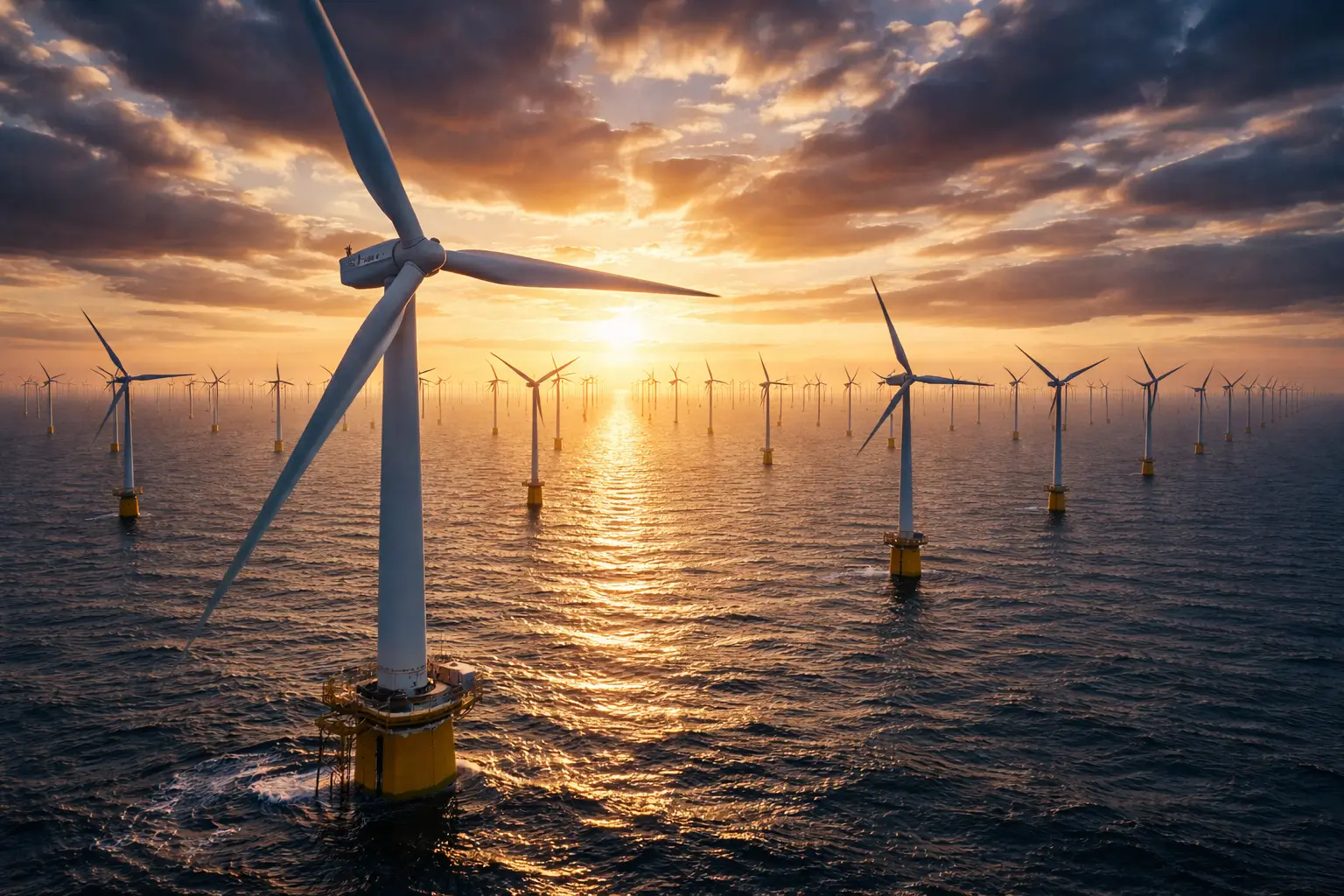
The future of Europe between the Green Deal and a new global tripod may ultimately depend on one brutal question: can Brussels turn climate ambition into geopolitical power before its industry loses the cost war?
As global politics shifts toward a harder, more transactional order, the European Union is doubling down on long-term energy transformation. Washington, by contrast, is leaning into cheaper fossil fuels and industrial competitiveness — a divergence that is reshaping transatlantic economics.
For American readers watching the balance sheet of global power, Europe’s strategy looks less like climate leadership and more like a massive strategic gamble.
The Davos Moment: Energy Becomes Hard Power
The current debate ignited after Donald Trump’s remarks at Davos, where he criticized wind power investments and questioned Europe’s economic logic.
“You’re supposed to make money with energy, not lose it,” Trump said, pointing to the stark gap between U.S. industrial electricity prices — around $0.08/kWh — and Europe’s near-$0.20/kWh reality.
Whether one agrees with Trump or not, his comments crystallized a deeper shift in U.S. thinking: energy is no longer just a climate issue — it is a competitive weapon.
Many analysts interpret this rhetoric as part of a broader geopolitical realignment, sometimes described as a global tripod — a world increasingly shaped by the strategic rivalry between the United States, China, and Russia, where Europe risks being perceived as a regulatory power rather than an industrial one.
Europe’s Answer: The North Sea Wind Alliance
In response to rising geopolitical pressure, nine European countries — Belgium, Denmark, France, Germany, Ireland, Luxembourg, the Netherlands, Norway and the United Kingdom — accelerated plans for a 100-gigawatt offshore wind hub in the North Sea.
European Energy Commissioner Dan Jørgensen framed the agreement as a strategic move toward autonomy, arguing that Europe must “reduce vulnerabilities and strengthen energy resilience.”
Supporters say the project could power roughly 50 million homes and create a new backbone for the European grid. Critics counter that offshore infrastructure introduces new security risks while failing to solve the immediate competitiveness gap with the United States.
Climate diplomat Jennifer Morgan described the initiative as a wake-up call:
“Energy independence is no longer just a climate objective — it is a geopolitical necessity.”
The Cost War: Why American Investors Are Watching Closely
For U.S. readers, the most consequential aspect of Europe’s strategy is not ideology — it is arithmetic.
| Metric (2025-2026 est.) | European Union | United States |
|---|---|---|
| Industrial Power Cost | ~€0.20/kWh | ~$0.08/kWh |
| Renewable Share | 30.1% | ~23–25% |
| Strategic Focus | Decarbonization | Cost Leadership |
Europe’s rapid expansion of wind and solar has reduced reliance on imported gas, but intermittency remains a structural challenge. Periods of weak wind in early 2025 forced temporary increases in gas generation, highlighting the limits of renewables without large-scale storage.
For American manufacturers and investors, the takeaway is clear: Europe is prioritizing long-term autonomy over short-term cost efficiency — a choice that could reshape global supply chains.
The Clean Industrial Deal: Brussels’ Attempt to Close the Gap
Recognizing the risk of industrial flight, the European Commission launched the Clean Industrial Deal in 2025. The strategy combines subsidies for decarbonization with the Carbon Border Adjustment Mechanism (CBAM), effectively taxing imports with higher carbon emissions.
In Washington, some trade analysts see CBAM as a form of “green protectionism” that could complicate transatlantic trade relations — particularly in steel, aluminum, and heavy manufacturing sectors.
Brussels insists the policy is defensive, not confrontational. But from an American perspective, it signals a Europe willing to reshape global trade rules in order to preserve its economic model.
A Continent Between Vision and Realpolitik
The deeper question is not whether Europe’s Green Deal will succeed environmentally. It is whether the strategy can survive in a geopolitical environment increasingly defined by energy affordability and strategic competition.
Europe is betting that technological innovation will eventually lower renewable costs and deliver autonomy. The United States, meanwhile, is betting that cheap energy will keep industry anchored at home.
For American observers, the stakes are obvious: if Europe’s bet pays off, it could redefine global energy markets. If it fails, the continent risks becoming a high-cost economy in a world where power — economic and geopolitical — increasingly follows energy.





Leave a Reply